Every week in my clinic, I hear something from parents that they don't quite realise is significant.
A parent tells me their toddler has been saying a word "a bit funny." They demonstrate it. The child's pronunciation is not disordered — it is American. The child has been learning words from a device with an American accent, and has reproduced those words in American English, with American vowel sounds and American stress patterns, because that is exactly what toddlers do.
They copy what they hear. Precisely. Consistently. Without editing or filtering. That is not a developmental issue. That is the mechanism of language acquisition working perfectly. The problem is what it is acquiring from.
What the Research Says About Accent Acquisition
Children in the early language acquisition window — roughly ten months to four years — are in a period of extraordinary phonological sensitivity. They are not just learning words. They are learning the phonological system of the language they are acquiring: the inventory of sounds, the stress patterns, the vowel qualities, the intonation contours.
Research in developmental phonology is clear that this system is formed primarily from the input a child receives during this window. The more consistent the input, the more robustly the system is built. And here is the clinically important part: input from media and devices counts as input. It is not filtered or discounted by the developing brain. A toddler who hears words spoken consistently in an American accent is building an American phonological system alongside the Australian one they are hearing at home.
The most common example I see clinically is the word "water." In Australian English, the medial "t" is distinct. In American English, it is typically flapped — essentially pronounced as a "d." A toddler who has learned "water" from an American device will often produce the American form, not because they are mimicking the device consciously, but because that is the form that was laid down during acquisition.
What This Means for Device Selection
The market for early learning audio devices is dominated by products manufactured overseas and designed for American English-speaking markets. These products are often cheaper, widely available, and aggressively marketed as educational. Many parents purchase them without being aware that the accent of the device is clinically relevant.
The question I get asked when I raise this in clinic is always the same: does it really matter?
For a typically developing child with consistent Australian English input from caregivers, it probably does not create a clinical issue. The home input will generally dominate. But it does slow phonological consolidation. It creates competing models for certain phonemes. And for a child who is already in the lower range for phonological development, it is additional complexity in a system that is already working hard.
Why AussieMate™ Is the Recommendation I Now Make Consistently
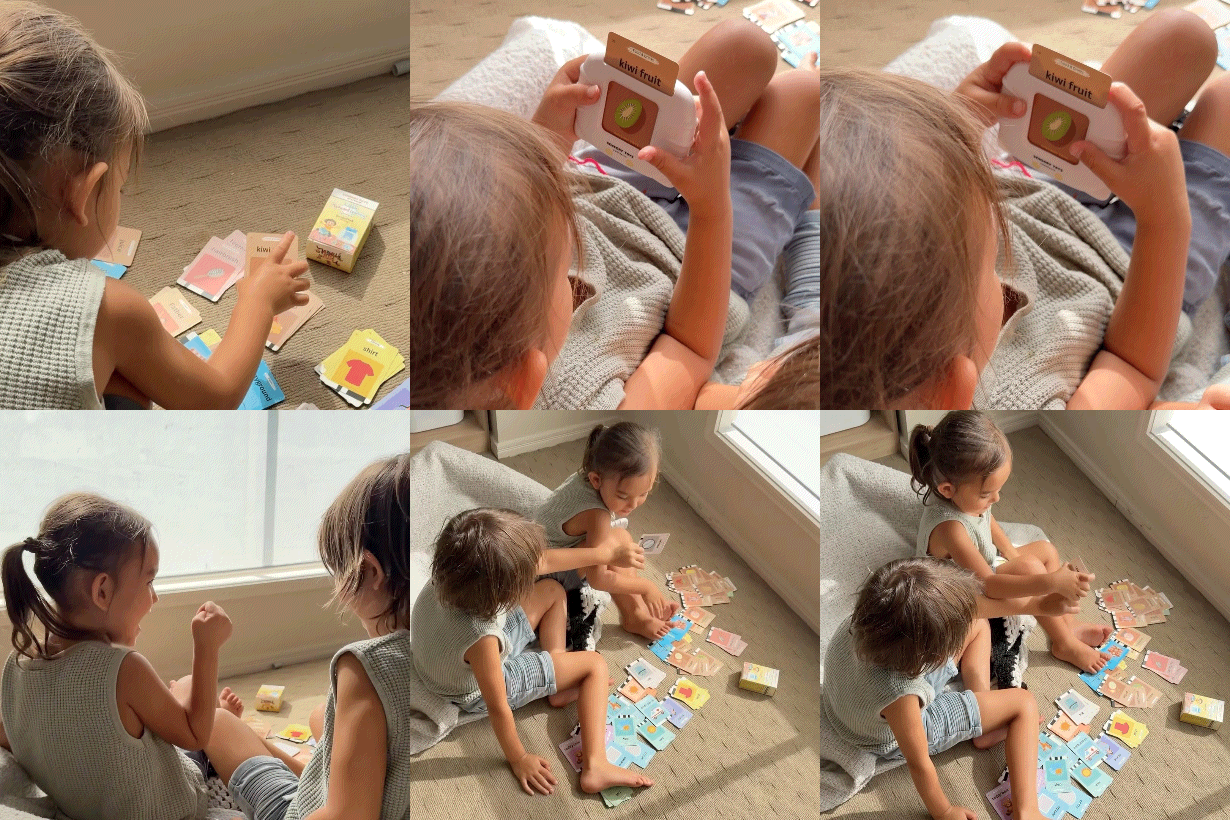
AussieMate™ is an Australian-made, Australian-accented audible flashcard reader. Designed on the Gold Coast, it uses a genuine Australian voice — not a processed or approximated one — to read words aloud as a child slides each card into the device.
From a phonological standpoint, it does what a learning device should do: it reinforces the same phonological patterns a child is hearing from their Australian caregivers. The vowels are right. The stress patterns are right. The intonation is right. A child learning "firefighter" from AussieMate™ hears it the way their parents say it.
It is also 100% screen-free, which aligns with current evidence-based recommendations for children under two and supports the kind of active, hands-on engagement that produces better language outcomes than passive viewing.
The device covers 224 words in the starter pack and up to 510 in the expansion — broad enough vocabulary to remain relevant from eighteen months through to school entry. Waterproof cards, USB rechargeable, storage bag included. $49.95 AUD, ships from Sydney, 30-day money-back guarantee.
The recommendation I now make to Australian parents who ask me about early learning devices is simple: choose an Australian voice. The phonology of your child's first words matters more than the price of the device producing them.