Parent Insight
5 Reasons the Accent on Your Toddler's Learning Toy Is More Important Than You Realise
Most parents choose early learning devices based on price, reviews, and card quantity. Almost none of them think about the accent. Here's why they should — and what we found when we finally did.
My son is three and he says "garbage" sometimes.
Not every time. Mostly he says rubbish, like the rest of us. But "garbage" slips out occasionally, in a slightly different vowel quality than his usual speech, and when I hear it I know exactly where he got it from.
We had a flashcard reader from an overseas marketplace for about eight months. It was cheap and it kept him busy and I never once thought about what accent it had until I started noticing him reproduce words in ways that sounded slightly off. Not wrong. Just not ours.
I found AussieMate™ when I started looking specifically for an Australian alternative. And what I learned along the way about why the accent matters changed how I think about every learning device I've considered since.
Five things I wish I'd known before I bought the first one.
5
Reasons the accent matters more than the price
from a parent who learned this the slightly hard way
This is not a figure of speech. It is the literal mechanism of language acquisition. Toddlers extract phonological patterns from the input they receive and reproduce them. They do not filter for accent. They do not adjust for dialect. They hear a voice, they acquire from it, and they produce what they acquired. A device used daily for months produces hundreds of hours of phonological input. That input shapes how your child speaks.
The differences go beyond accent into actual vocabulary. Nappy versus diaper. Rubbish versus garbage. Lollies versus candy. Zed versus zee. A device with an American voice will use American vocabulary for some concepts — and your child will learn and reproduce those American words, because the device is authoritative to them. They have no reason to doubt it. They just copy.
When a toddler hears the same words in two different accents — Australian at home, American from the device — they are building two competing representations of each word. Speech pathologists describe this as creating "dual-input conditions." For most typically developing children it eventually resolves. But it adds complexity to a system that is already doing significant work. A device that matches the home accent removes a source of competing input.
It is not that manufacturers chose an American accent for Australian products. It is that they didn't think about Australian products at all. The devices were made for a global market dominated by American consumers. Australian families are an afterthought, if they are a thought at all. AussieMate™ was designed specifically for Australian children, by Australians, on the Gold Coast. That is not a small distinction.
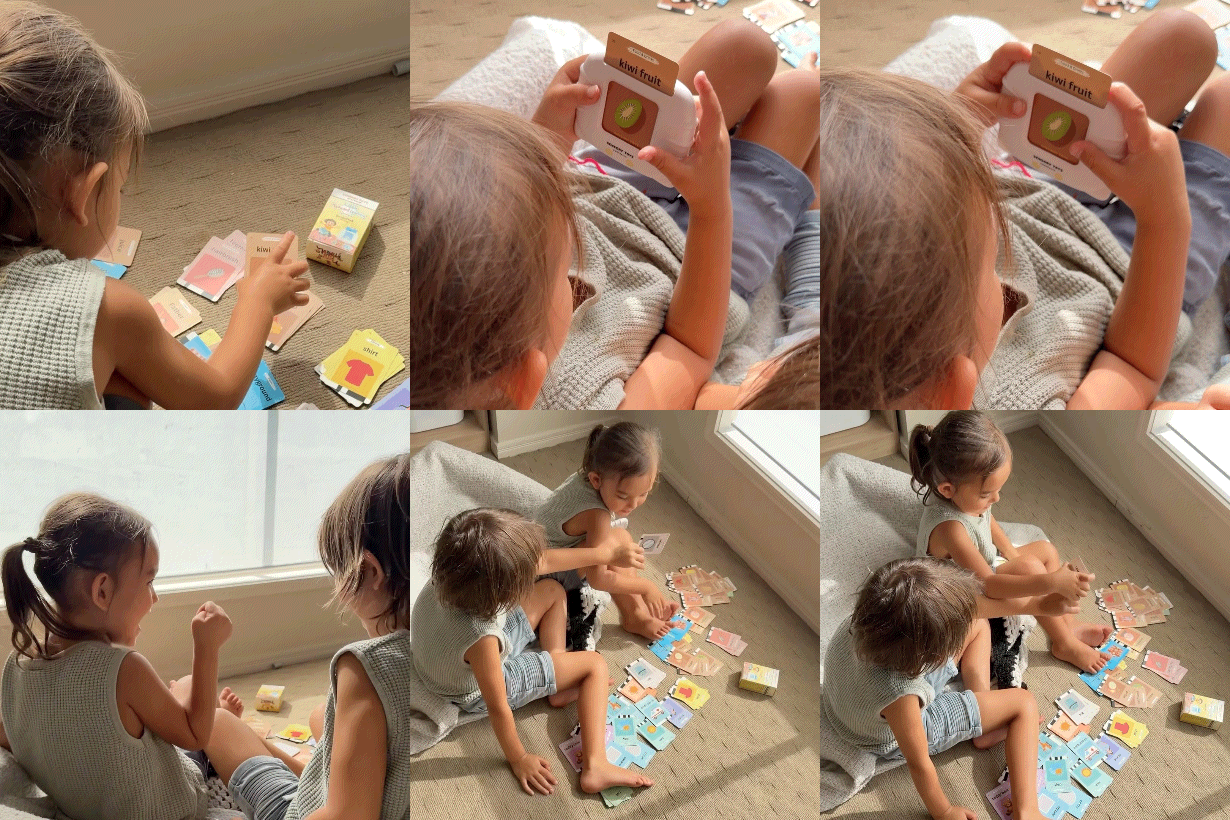
There is a subtler effect that is harder to measure but clear to observe. When a child hears a voice that sounds like the voices in their life — like their parents, their grandparents, their educators — something clicks that doesn't click with a foreign voice. The words land differently. The familiarity creates engagement. My son uses the AussieMate™ the same way he'd repeat something back to me: naturally, confidently, in his own voice.
My son still says "garbage" occasionally. It's fading. The AussieMate™ has been in our house for eight months now and the Australian vocabulary is taking over the American one in the same gradual way it arrived.
Starter pack $49.95 with 224 cards. Expansion pack available for 510 total. Ships from Sydney in 24 hours. 30-day money-back guarantee.
The voice that sounds like home.
AussieMate™ — genuine Aussie accent, 510 words, 100% screen-free. Ships from Sydney. 30-day money-back guarantee.
See AussieMate™ →
✔ 30-Day Guarantee✔ Ships in 24hrs✔ 🇦🇺 Aussie Owned