The Science
Why the "video deficit effect" matters for early learning device design
The video deficit effect is one of the most consistently replicated findings in early childhood research. It describes the systematic gap between what toddlers learn from screen-based media versus equivalent live or hands-on experience. Across dozens of studies, children under three show measurably worse retention, comprehension, and application of material presented via screen compared to the same material presented through physical interaction.
The effect is largest under age two and remains significant through age five. It persists even when the screen content is specifically designed to be interactive, educational, and age-appropriate. The mechanism is not content quality. It is the modality itself.
Screen-based input activates a narrower range of neural pathways than hands-on physical interaction with objects. The combination of motor action, tactile input, auditory output, and active verbal response — all present in well-designed physical learning tools — produces significantly stronger consolidation and retention than passive or touchscreen-based input alone.
The Three Conditions
What hands-on learning activates that screens don't
Research in early childhood cognition identifies three conditions that most strongly predict vocabulary retention in the eighteen-month to five-year window. Screens consistently fail to activate all three simultaneously. Physical learning tools, at their best, activate all of them at once.

The Design
How AussieMate™ activates all three conditions in a single interaction
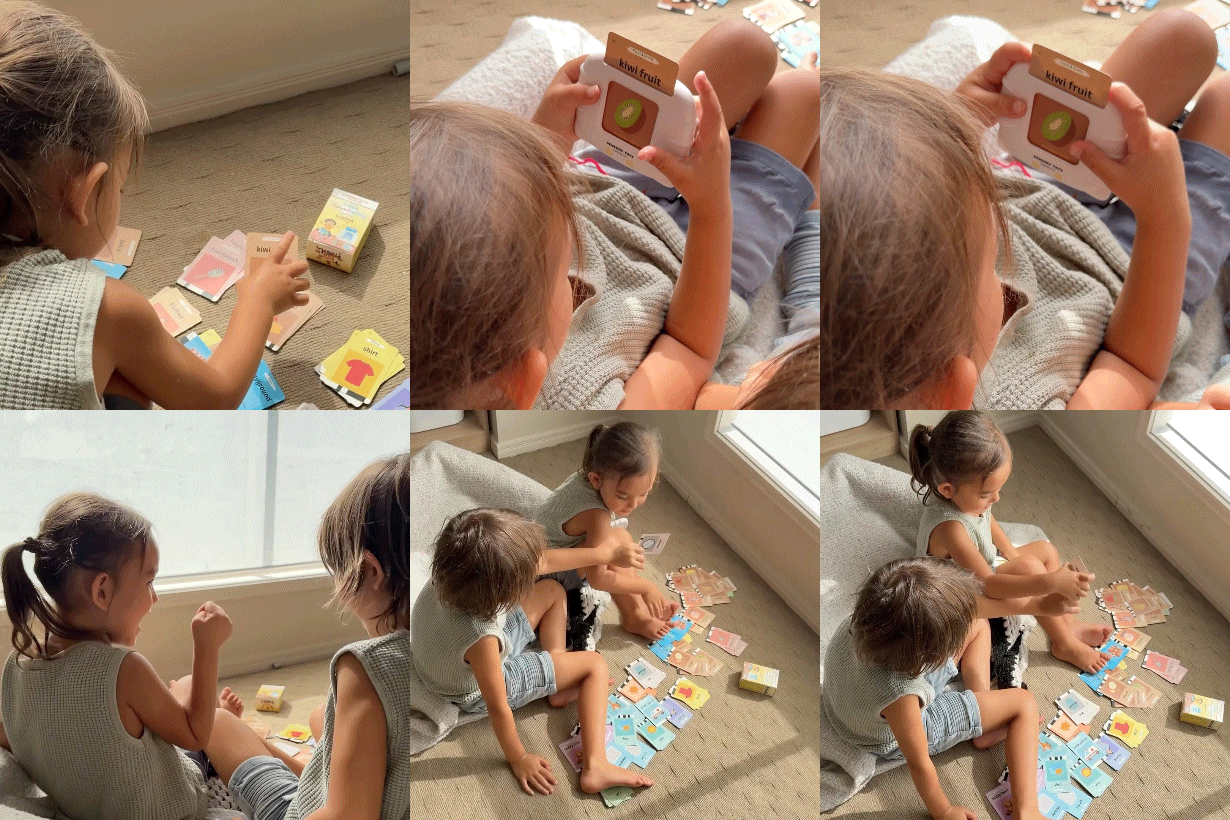
The AussieMate™ interaction is: pick up a card (physical action), slide it into a slot (physical action), hear the word spoken in an Australian accent (auditory input matched to the child's home phonological environment), and say the word back (verbal output, self-directed and self-corrected as many times as the child chooses).
That is the three-condition loop, activated in under three seconds, repeatable indefinitely at the child's own direction, with no adult supervision required and no screen involved.
The card range extends from 224 foundational words in the starter pack to 510 across the full expansion — sufficient vocabulary breadth to keep the device relevant from eighteen months through to school entry. Cards are waterproof and have proven durable across years of real toddler use. The device is USB rechargeable with no button batteries.
The screen guilt that parents feel is a signal worth listening to. It is not anxiety or perfectionism. It is an accurate observation that the screen modality, even at its educational best, is producing a lower-quality learning experience than the alternatives — and that the alternatives, until recently, weren't engaging enough to be practical.
AussieMate™ is the practical alternative. The three-condition loop works. The engagement is real. And no screen is involved.