The Science
How toddlers acquire accent — and why devices count as input
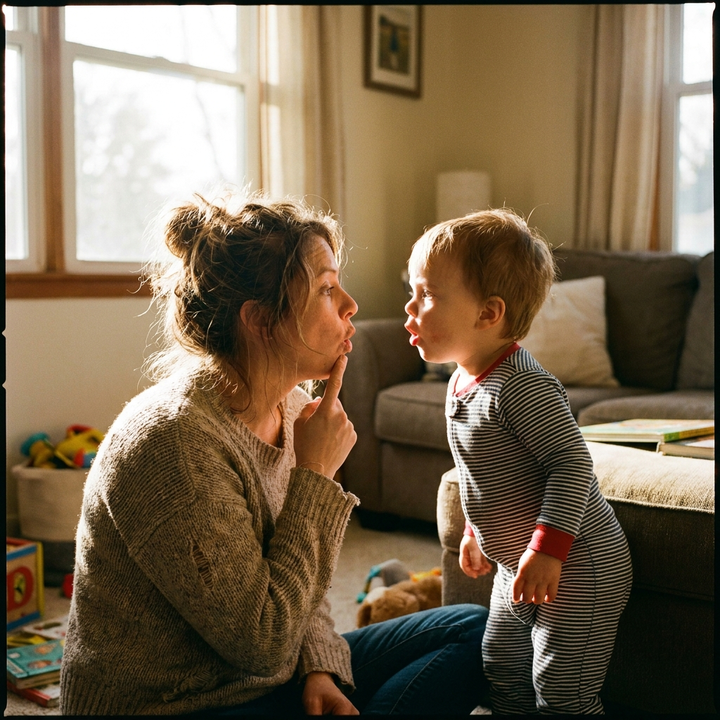
The phonological system of a language — its inventory of sounds, its vowel qualities, its stress patterns, its intonation — is not taught explicitly. It is acquired through exposure. A child does not learn that Australian English has a certain quality to the vowel in "face" or "goat" by being told so. They hear it, thousands of times, from the people and media around them, and their developing auditory system extracts the patterns.
This process is well-documented and well-understood. What is less well-understood, in the popular parenting conversation, is that electronic devices count as input in exactly the same way that caregivers do. A toddler's brain does not distinguish between the voice of a parent and the voice of a device. Both are processed as phonological input. Both contribute to the system being built.
Studies in phonological acquisition have demonstrated that toddlers exposed to non-native accent input through media and devices show measurable differences in vowel production compared to controls. The effect is proportional to the quantity and consistency of exposure — a device used daily for months produces a more significant effect than occasional media consumption.

The Problem
Why most learning devices on the market have the wrong voice for Australian children
The global market for early learning audio devices is dominated by products designed for American English-speaking markets. These products are cheaper to produce, widely distributed, and aggressively marketed internationally. They were not designed with the phonological development of Australian children in mind. They were designed for a different child, in a different country, with a different phonological system.
When an Australian toddler uses one of these devices daily, they are receiving consistent phonological input in a dialect that differs from the one they are acquiring at home. The differences include vowel height and quality, the presence of rhoticity (the American "r"), stress placement, and intonation contours. These are not superficial differences. They are differences in the phonological substrate of the language.
The Solution
Why AussieMate™ is the clinically sound choice for Australian families
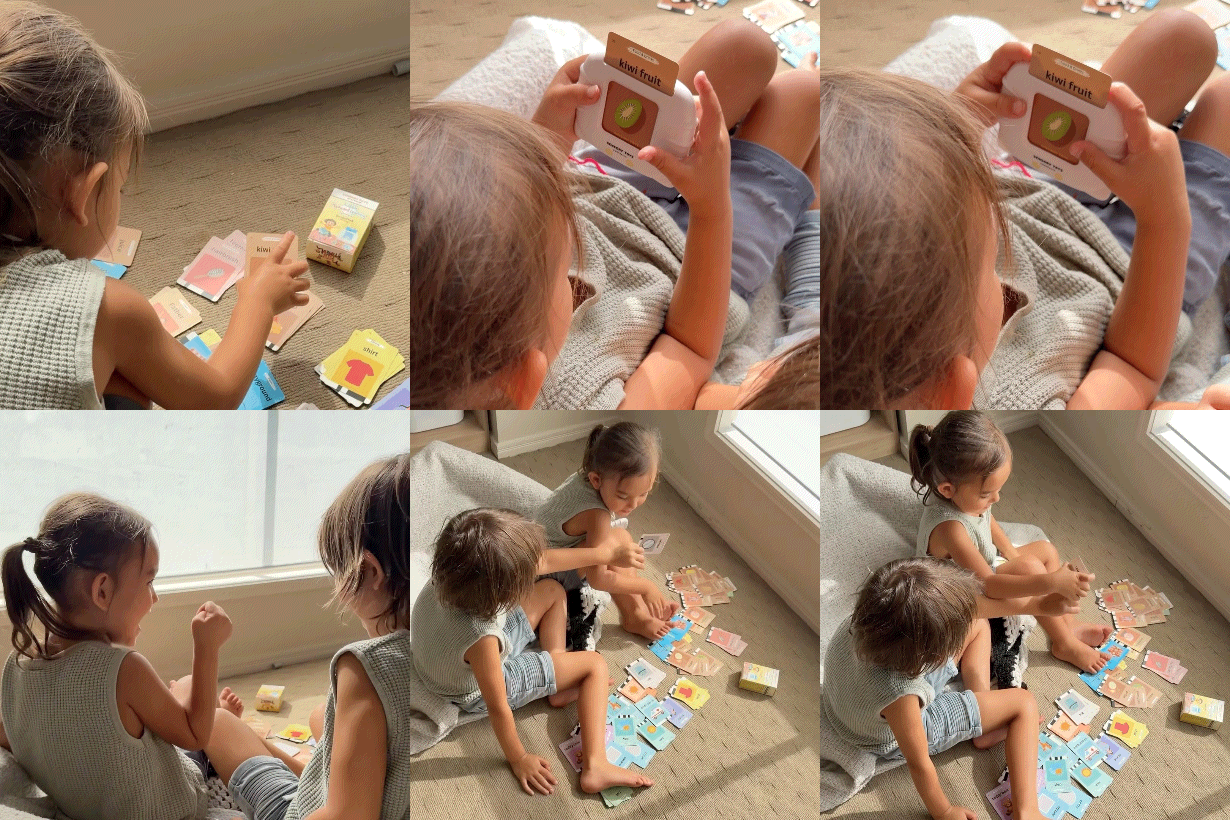
AussieMate™ is an Australian-designed, Australian-produced audible flashcard reader with a genuine Australian accent. It covers 224 words in the starter pack and up to 510 in the expansion — appropriate vocabulary for children from eighteen months to five years.
From a phonological standpoint, it does what a learning device should do: it reinforces the phonological patterns a child is acquiring from their Australian caregivers rather than competing with them. It is also completely screen-free, USB rechargeable, and uses waterproof cards that survive the conditions of actual toddler use.
The voice on the device sounds like the people in an Australian child's life. That is not a marketing claim. It is the fundamental prerequisite for a device that supports rather than complicates the phonological development of an Australian child.